Since Tranche 2 of the Anti-Money Laundering and Counter-Terrorism Financing (AML/CTF) reforms, regulated by the Australian Transaction Reports and Analysis Centre (AUSTRAC), took effect on 1 July 2026, many firms have worked out their customer due diligence (CDD) process for individual clients. Onboarding companies and trusts is a different matter. There are more parties to identify, more documents to review, and more room for error.
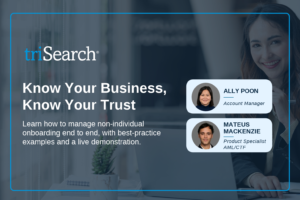
This session walked through non-individual client onboarding step by step, covering both Know Your Business (KYB) and Know Your Trust (KYT), within the triSearch Compliance Centre. KYB is the due diligence a firm carries out on a company client, and KYT is the same for a trust. Both help firms meet their AML/CTF obligations when the customer isn’t an individual.
Mateus MacKenzie, AML/CTF Product Specialist, ran the session on 15 October, hosted by Ally Poon, Account Manager. Mateus worked with an AML technology provider in New Zealand and United Kingdom, where lawyers and conveyancers have had equivalent obligations, so he’s seen how they apply in practice.
What does Know Your Business due diligence involve?
For every company client, there are four things to work through:
- Verify that the company legally exists, and understand its structure: who’s registered and what type of company it is
- Understand the ownership and control structure, including directors, shareholders, and how decisions get made
- Identify and verify the beneficial owners: individuals who own 25% or more of the company, or who control it
- Record the identification and verification details gathered and store it so it supports compliance and is retrievable if it’s ever reviewed
Where company onboarding gets complicated
The straightforward files aren’t the problem. The ones that catch firms out are incomplete beneficial ownership chains, where ownership sits behind another company or trust, layered corporate structures, and companies with an offshore parent or director.
Doing this across manual ASIC searches, spreadsheets, and disconnected systems leads to duplicated information and inconsistent records, especially when you’re under pressure to onboard a client.
What does Know Your Trust due diligence involve?
Much of the underlying obligation is the same, but trusts add a deed to review and more parties to identify. A trust isn’t a legal entity. It’s a relationship set out in a trust deed between a trustee, the beneficiaries, and sometimes an appointor or settlor. Discretionary, unit, testamentary, and bare trusts each bring different requirements for who you need to identify.
There are five things to work through:
- Identify the type of trust, and obtain and review the trust deed, which everything else depends on
- Verify the trustees, whether they’re individuals, companies, or another trust, because trustees control the trust
- Identify the beneficiaries, or where the deed names a class rather than individuals, understand and document that class
- Where the deed names one, identify the appointor or settlor, who often hold significant control without being a trustee or beneficiary
- Record the identification and verification details and store it in a way that supports compliance and stays retrievable
The scenarios that tend to cause trouble are discretionary trusts with broad or loosely defined beneficiary classes, family trusts connected to other entities you’re also onboarding, and the different verification requirements that apply by trust type.
Why do trust amendment deeds matter?
Mateus’s key recommendation was to collect the trust deed and every amendment deed upfront.
Many trusts were established years or decades ago and have been varied since. Those amendments can change the trustee, the appointor, the beneficiaries, or other controlling parties. Working from the original deed alone means working from a structure that may no longer exist. With the complete and current documents, you can confirm the trust type, identify who controls it, and apply the verification requirements that fit that trust type.
What’s coming for corporate trustees
Clients have asked us to add corporate trustees to the Know Your Trust workflow. We’re building this now, and attendees saw a preview during the session. We’ll let clients know through their Account Manager when it’s available.
The takeaways
Whether you’re onboarding a company or a trust, the steps are the same: verify the entity, identify the relevant parties, and store the record so it supports compliance and stays retrievable. In the triSearch Compliance Centre, that all happens in one workflow, with the same process for companies and trusts, so your team isn’t switching systems.
Getting the structure right at the start is what helps reduce risk and rework later on.
Missed the session?
Watch the recording below for the full walkthrough and the questions Mateus covered.
Still working through a company or trust file, or need help with your triSearch Compliance Centre? Contact your Account Manager or book a demo.
triSearch provides software solutions for conveyancing processes. Users remain responsible for compliance with applicable laws and regulations. This recap is general information only and isn’t legal advice.